
St. Peters City Directory Collections
The St. Louis County Library directory inventory is the principal verified source for the St. Charles material that may reach St. Peters. It lists St. Charles city issues on microfilm and later print or reference issues. Their labels matter. A St. Charles city volume can omit St. Peters, so geographic coverage must be checked in the actual book before treating a missing name as meaningful. The verified county phone books are the more direct late-century option.
| Collection | Years | Where Held | Access |
|---|---|---|---|
| St. Charles city directory microfilm | 1906; 1925-32; 1934; 1936; 1938-39; 1941-42; 1948; 1950; 1952; 1955; 1957; 1959 | St. Louis County Library inventory | Microfilm; verify St. Peters coverage in each volume |
| St. Charles city print/reference holdings | 1966; 1973-74; 1987; 1988 | St. Louis County Library inventory | Print or reference; ask about local access terms |
| St. Charles County phone book | 1987-88; 1989-90 | Library-listed county holdings | 1987-88 expressly includes St. Peters, O'Fallon, Weldon Spring, and other communities |
| St. Charles/Wentzville regional phone book | 1988-89; 1990-91 | Library-listed regional holdings | Regional comparison for nearby or edge addresses |
No official St. Peters-specific digitized directory scan, separate reverse directory, first St. Peters-specific issue, or final printed year was located. Missouri Digital Heritage explains the kinds of details that directories can contain, but its city-directory coverage is mostly St. Louis with limited other cities. Treat the listed gaps as gaps, not as proof of a break in a household's history.
Start each search by recording the volume title, place label, year, medium, page, and spelling. That small citation makes it possible to revisit a result when a city label, street form, or surname later changes.
St. Peters County Directory Anchor
The 1987-88 St. Charles County phone book is the clearest local anchor because the library's parenthetical expressly names St. Peters along with O'Fallon, Weldon Spring, and other county communities. It is stronger evidence of intended geographic reach than a city-only St. Charles volume. The 1989-90 county book supplies a follow-up point, while the 1988-89 and 1990-91 regional books can help with an address near a postal or municipal edge.
The library's collection listing is the source for this late-1980s run.
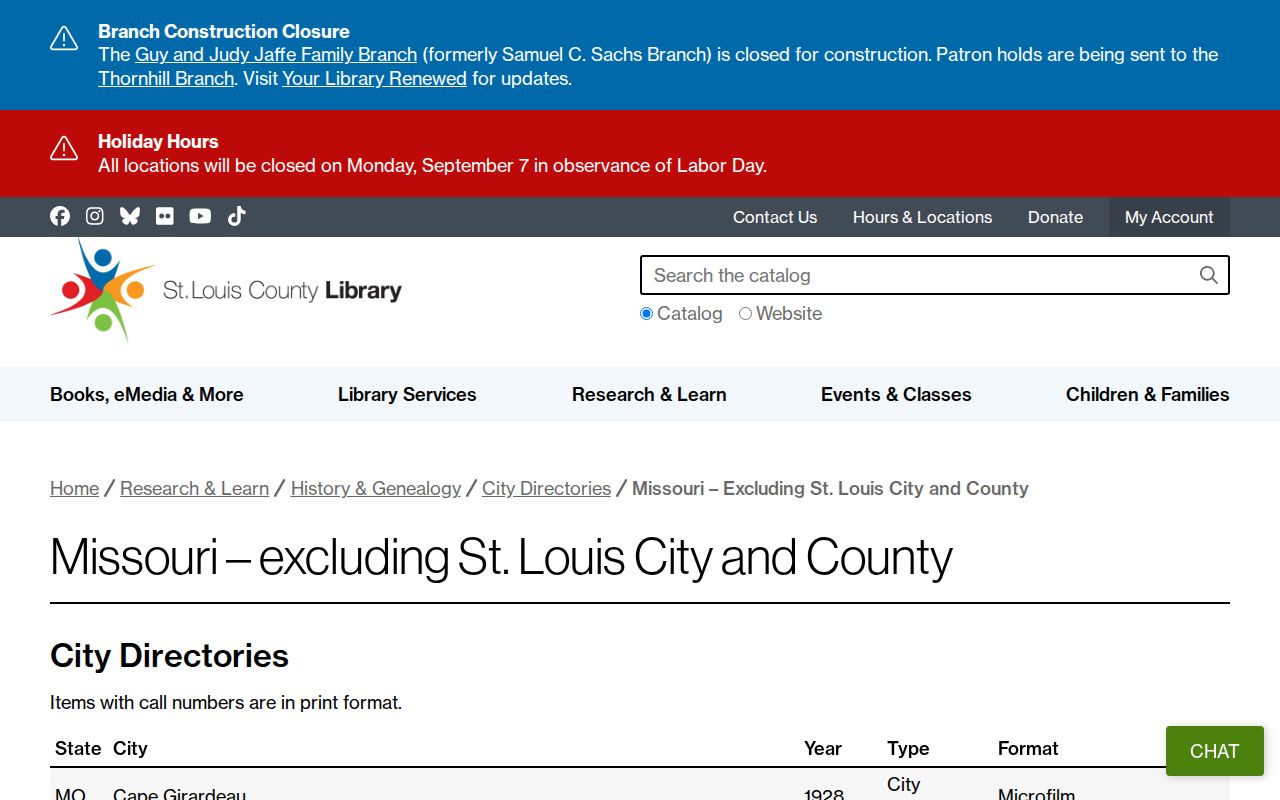
The collection view supports a shelf-first approach: identify the county or regional book whose title actually includes the desired area, then compare its entry with the nearest available year. It does not establish that every St. Peters household appears in every listed volume.
Search St. Peters City Directories
Begin with the surname, then repeat the search with a full given name and an initial. Older material can place the same area under St. Peters, Saint Peters, or St. Peter's. Test road and street abbreviations, house-number ranges, a prior married name, a business name, and a phone number when the volume supports those approaches. An address, cross street, or subdivision can be more useful than a surname when spelling shifts across years.
Some later volumes may provide an address-ordered section, but the official library page does not confirm a separate St. Peters reverse or criss-cross run. Look for the terms “reverse directory,” “criss-cross,” “street directory,” and “telephone directory” in the shelves or catalog before assuming an address-to-name index exists. Do not force an address search through a surname-only volume.
A name absent from one book can reflect a move, a married-name change, an abbreviated entry, an editorial cut-off, or coverage outside the book's geographic reach. Compare the prior and next available year before treating an absence as a final result.
Reading a St. Peters City Directory
No actual St. Peters directory page or named entry was opened in the verified source set. For that reason, the inventory below is a transcription checklist, not a reconstructed sample line. Copy only what the physical volume displays. The source may show some, all, or none of these details, and a named publisher should not be assigned without a visible title page.
| Entry detail | What to preserve if displayed |
|---|---|
| Name | Surname, given name or initial, and the spelling exactly as printed. |
| Household clue | Spouse, married-name, widow or widower notation, or a forwarding or cross-reference note. |
| Address and phone | Street form, house number, telephone, or address cross-reference, with the page number. |
| Activity detail | Occupation, employer, or business name only when the physical entry shows it. |
| Volume citation | Year, collection, medium, abbreviation key, publisher if shown, and the page. |
- Criss-cross
- An address-ordered or street-ordered companion section, if the particular volume includes one. Its existence for a St. Peters run still needs verification.
- Householder index
- An index arranged around household names rather than a complete statement of everyone at an address. Check the volume's own arrangement.
- Abbreviation key
- The volume's explanation of shortened words and marks. Photograph or transcribe it before interpreting a notation.
Entries can suggest a presence or contact point. They are not proof of ownership, continuous residence, or the legal status of an address.
St. Peters Directory Years in Context
Directory timing should follow the local record landscape. St. Peters was incorporated in 1910, so a person or place before that date may be indexed under St. Charles County, a settlement name, a church, or a rural land description rather than under a modern St. Peters city label.
- Before 1910: use county deeds and tax material, church records, early census sources, and newspapers before expecting a St. Peters city label.
- 1910-1959: test the listed St. Charles city directory runs and verify whether each volume reaches the town.
- 1966-1988: consult the library's print and reference holdings as a bridge into suburban expansion.
- 1987-1991: compare the county and regional phone-book sequence, especially the 1987-88 county volume that expressly includes St. Peters.
- Later research: use parcel, deed, city, and library sources rather than implying a directory run that was not located.
The St. Charles City-County Library genealogy gateway is a practical local access point for census, directories, newspapers, maps, photographs, yearbooks, probate, and land resources. Its St. Peters branch is at 77 Boone Hills Drive and can be reached at 636-441-2300. Database access terms vary, so confirm whether a needed title requires a card or in-library use.
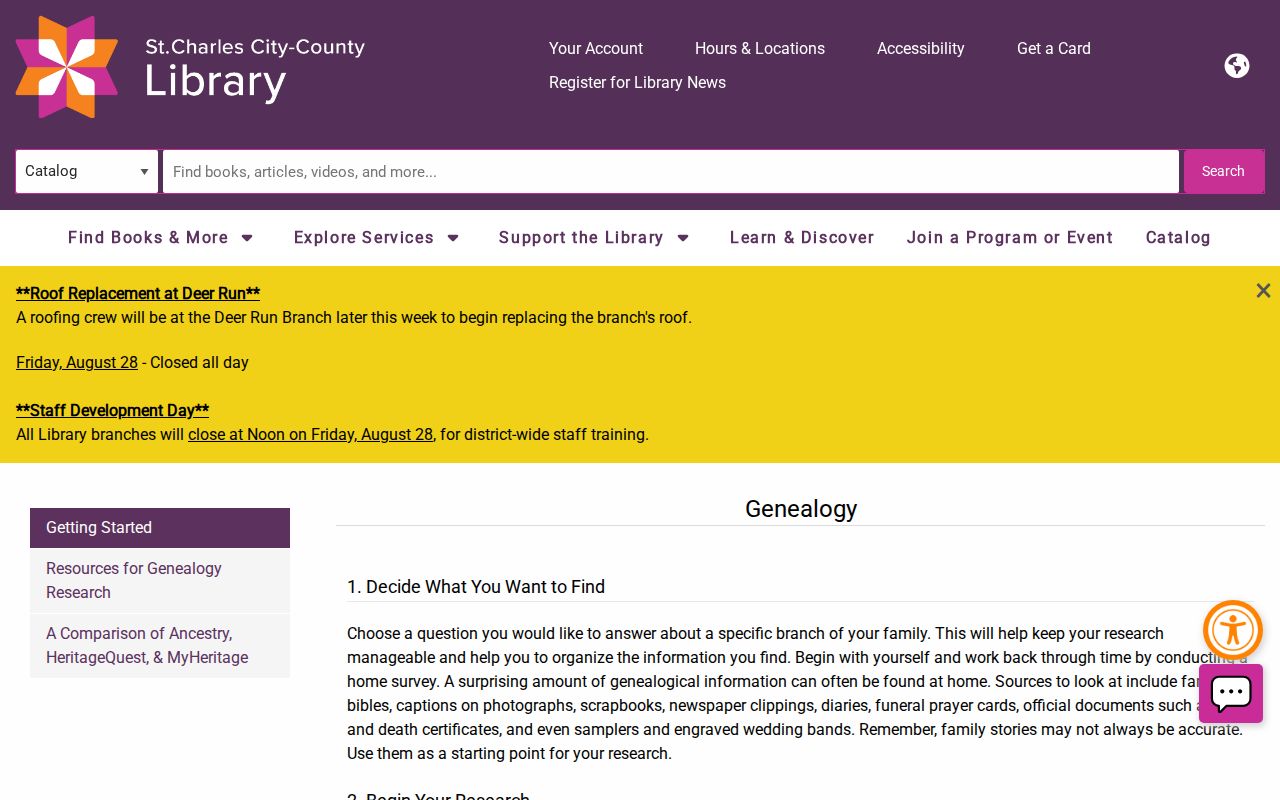
Library databases can help triangulate a directory result with a census, newspaper, yearbook, photograph, or land record. Their licensed access does not turn a library search result into a civil record.
Trace St. Peters Directory Households
For a household trail, choose the closest known name or address and build outward one available year at a time. Keep a simple dated log instead of merging uncertain entries. When a name disappears, the next step is comparison, not assumption: test a surname variant, a different city label, a nearby county or regional book, and the prior or following issue.
- Find the closest available directory year and transcribe the complete entry with its page and volume details.
- Compare the preceding and following available years for address moves, household clues, phone changes, or altered spellings.
- Search by street, cross street, subdivision, or a verified reverse section only when that volume actually supports it.
- Pair the dated entry with the public census years that fit the period, then check deed or tax material for the parcel.
- Use an obituary, probate lead, church record, or newspaper item to test whether a disappearance reflects a move, death, or simple omission.
For early families, the St. Charles County Historical Society can add a personal bridge. Its research holdings include local newspapers, directories, property and tax material, maps, family-history files, and photographs. The society's burial index includes All Saints Catholic Church in St. Peters, while original burial records remain with the church. Confirm current hours and research-service terms before relying on a visit.
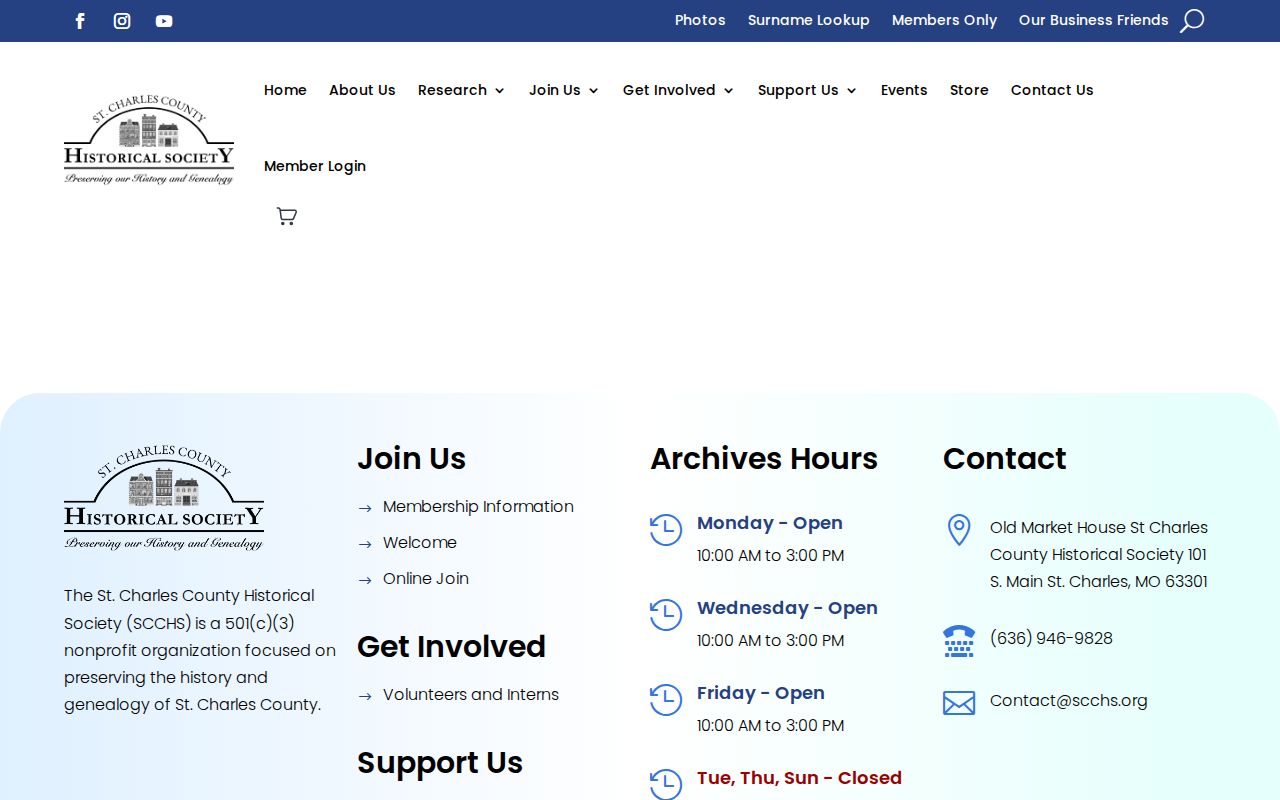
That repository can place a directory clue beside local papers, maps, tax material, and family files. Each source answers a different question, so keep its date and custodian with the finding.
St. Peters Directory Name Variants
Directory research works better when the original spelling is preserved and a small set of alternatives is tested. Search St. Peters, Saint Peters, and St. Peter's where the catalog or volume permits. Test a surname with and without a middle initial, common road abbreviations, a married name, and a nearby street or subdivision. Older compilers and later catalogers did not always use the same place form.
Keep every tested variant in the research note with the directory year and page. A different spelling can explain a missed entry, while a different address, spouse notation, or business line may show that two similarly named entries are not the same household.
St. Peters Directory Proof Limits
Use a directory entry as one dated clue, not as legal or occupancy proof. A deed documents a recorded conveyance, tax and parcel records describe an assessment snapshot, a census has its own enumeration date, and a church or obituary source records a separate event. Agreement among several dated sources is more useful than treating any single line as conclusive.
For St. Peters addresses, compare the city label used in the book with the county and parcel context. The changing boundary, postal, and compilation labels around the area are exactly why the title page, volume year, page, and geographic coverage belong in every research note.
Before the 1910 incorporation, the stronger search path is often St. Charles County rather than St. Peters. County tax, deed, church, territorial census, newspaper, and settlement records can carry the needed name or land description. Later municipal material belongs in its own custody stream. Keep the county record, city label, and directory volume separate rather than projecting today's city name backward onto an early source.
Note: Preserve the source's spelling and wording, even when a later record uses a different city name or street form.